1987
His Property (A Dark Vampire High School Bully Romance) (Vampire Boy Swords): Prince of Londinium (Dead Sun: Prince of Londinium (A Dark High School Bully Romance) (Vampire Boy Swords) Book 1)1987 is more than the year associated with Clara Driscoll’s childhood: it is the hidden temporal setting that separates her from her royal origin and conceals the political violence of the twenty-sixth century. By placing Clara in an era centuries before Londinium existed, the story turns a date into a mechanism of secrecy, dislocation, and recovered identity.
The Hidden Past
1987 enters the narrative through Clara’s discovery that she had been stolen and hidden there. At the ball in the Emperor’s Palace, she realizes that her life in that earlier era may have been constructed around a lie: she may be the lost Empress’s child rather than the daughter of James Driscoll, and the woman she called her mother may not have been her true mother. The revelation makes her memories unstable, because the ordinary family history attached to 1987 no longer explains who she is.
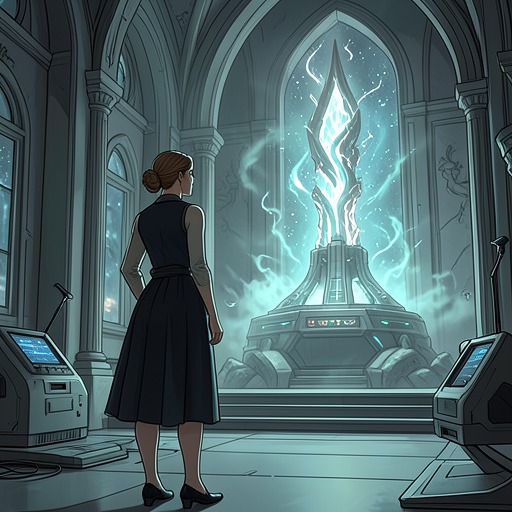
The temporal distance is enormous. Clara’s remembered life belongs to 1987, while the ball takes place in the twenty-sixth century, in the underground city of Londinium. The contrast between the familiar past and the technologically transformed future gives the date its narrative force: 1987 is the apparently ordinary world from which Clara has been removed, while Londinium is the concealed historical order that now claims her blood, title, and allegiance.
A Date Between Historical Eras
The explanation given to Clara links 1987 to a much longer chronology. The account begins in ancient Briton, where the Taleians and the Druids existed as separate races, and continues through the Taleian curse, the deaths of the Queen and the Knight of Swords, the emergence of a hybrid Queen in 1893, and the later civilization of the twenty-sixth century. In that sequence, 1987 sits between the recorded history of the Taleian people and Clara’s eventual return to their world.
The year therefore functions as a historical blind spot. Clara grew up in an era that did not know the truth about the Taleians, their vampire transformation, their royal lineage, or the succession crisis surrounding the Empress. Her removal to 1987 did not merely hide a child in another place; it interrupted her access to an entire political and biological history. When she returns to Londinium, the past she thought she possessed collides with a past that had been deliberately withheld.
Identity and Temporal Displacement
Clara’s movement from 1987 into Londinium produces the central identity rupture of the story. She initially insists that she does not belong in Londinium or in the twenty-sixth century, yet she recognizes that this rejection is not wholly truthful. Her resistance reflects the habits of a life formed in 1987, while the claims made upon her arise from a lineage established long before that year and still active in the future.
The date also explains why Clara experiences the revelation as a loss of home rather than as a simple promotion into royalty. Learning that she is connected to the lost Empress and that her apparent family history was false removes the emotional ground beneath her. The fact that she was hidden before Londinium existed makes her biography a form of historical exile: she has lived outside the world whose conflicts, rituals, and succession make her identity intelligible.
Political and Ritual Consequences
Clara’s concealment in 1987 has consequences beyond personal memory. In Londinium, her lineage places her at the center of competing claims governed by the Book of Talus, the ancient Taleian bonding ritual, and the rule of courtship. The Book of Talus is said to name a child’s fated mate at birth, while several duels are required before two mates can be joined by blood and establish a psychic bond. Clara’s temporal displacement has left her unaware of these institutions even as others interpret her according to them.
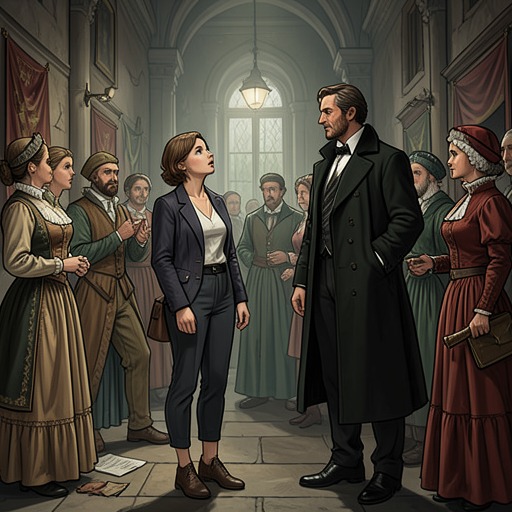
Her ignorance becomes part of the conflict at the palace ball. Byron Phraeon treats a kiss on the cheek as a muted form of courtship and claims that he has staked his claim, while Darius Constantine rejects that interpretation as an improper use of the ancient bonding ritual. Clara, whose life began in the social world of 1987, experiences the dispute as an attempt to discuss her as property. The clash shows how the future’s ritual laws can reach backward across centuries and attempt to determine the life of someone raised outside them.
Narrative Significance
1987 gives the novel its strongest contrast between lived memory and inherited truth. Clara’s return from that year exposes how historical knowledge can be controlled: the past is not simply forgotten, but arranged so that a royal child can grow up under another identity while the rulers of the future preserve or suppress the meaning of her bloodline. The date thus marks both the beginning of Clara’s apparent life and the concealment of the political crime that made that life possible.
Its significance deepens when Octavius explains that the Emperor murdered the Empress, her child, and the Princes who protected her. Against that history, Clara’s presence in Londinium suggests that the child’s survival depended on removal from the future’s reach. What looked like an ordinary birth and upbringing in 1987 becomes evidence of a hidden succession. The year remains the temporal seal on Clara’s stolen identity, and her arrival in Londinium is the moment when that seal begins to break.